
ADHD & Hyper-independence
When asking for help feels harder than doing it alone

I am a millennial woman, oldest daughter (legit all the stereotypes), who was diagnosed with ADHD at age 33, because after holding everything together for myself my whole life, I had a mental breakdown when I became a mom. I feel this deeply on a personal and human level, and also see it daily with the incredible humans I work with as a therapist.
There’s a specific kind of exhaustion that comes with the chronic feeling like you have to do everything on your own.
It’s struggling silently. Over-functioning on auto-pilot. Trying to hold everything together without letting anyone see how overwhelmed you actually are or how hard things actually feel.
Not because you want to do everything alone, but because asking for help can feel uncomfortable, vulnerable, or even unsafe.
A carefully curated facade that looks like independence, competence, and having it all handled.
But when the mask comes off, it often feels like carrying far more than your brain (and body) was ever meant to hold by itself.
It’s not just independence, it’s self-protection
Hyperindependence is often a response to repeated experiences of feeling misunderstood, criticized, or unsupported.
For many people with ADHD, asking for help doesn’t feel easy.
As a child (and even throughout later life), you might have been told:
“you just need to try harder”
“you’re capable, so why aren’t you doing it?”
“you’re making excuses”
Or maybe people stepped in only after you were already overwhelmed.
So over time, you internalized the message, “It’s easier if I just do it myself”, even when it’s exhausting.
Why asking for help can feel so hard
ADHD already comes with challenges around:
organization
follow-through
remembering things
regulating emotions
managing overwhelm
And when shame gets layered on top of that, asking for help can start to feel like admitting failure.
So instead, you might:
push yourself past your limits
avoid telling people you’re struggling
overcompensate to prove you’re capable
feel guilty needing support at all
Not because you don’t need help, but because somewhere along the way, needing help stopped feeling safe.
“But I can handle things on my own…”
And the truth is you can…but at what cost. You have likely handled so much on your own.
You:
show up for other people
function well under pressure
figure things out when you have no other choice
appear high-functioning from the outside
So why does everything still feel so heavy?
Because surviving independently and being supported are not the same thing.
Just because you can carry everything alone, doesn’t mean you were meant to.
What hyper-independence actually looks like
It’s not always obvious. It can look like:
saying “I’m fine” when you’re overwhelmed
struggling privately instead of reaching out
feeling uncomfortable receiving help
struggling to even identify what help or support you need
trying to solve every problem yourself
taking on too much before asking for support
Not because you don’t trust other people completely, but because your brain has learned to rely only on you.
The part people don’t see
Hyper-independence is rarely empowering. It’s often:
mental exhaustion from carrying everything yourself
feeling lonely even when people care about you, resentment from never feeling supported
difficulty relaxing because you’re always “on”
fear of being perceived as incapable or too much
You’re constantly trying to stay ahead of overwhelm without letting anyone see how hard it actually feels.
Why ADHD can increase this pattern
ADHD often comes with years of:
masking struggles
compensating for executive dysfunction
trying to avoid disappointing people
feeling “behind” compared to others
not being able to identify how someone could support you
So many people who are neurodivergent learn to over-function as a way to protect themselves from shame.
If you do everything yourself, you don’t risk: forgetting something, relying on someone who may not follow through, being judged for struggling, or feeling like a burden.
Hyper-independence can start to feel safer than vulnerability, even when it’s hurting you.
Another perspective
Another part of asking for help that is challenging for individuals with ADHD is knowing what would actually be helpful. When you are used to doing things by yourself, it can be hard to know what someone else could do to help. It can also feel like more of a chore to explain to someone how to do something, which reinforces the idea of “it’s just easier to do it myself” or “I can do it better.”
A personal example of this that makes me laugh a bit now…a few months back I was moving into a new office with my business partners. I had mapped out the details meticulously of where I envisioned things going. There was an issue with the rug that I ordered in my office and when my partner asked how he could help me fix it, I literally shut down, because the truth was, I was so overwhelmed, the idea of having to send the rug back and order a new one was too much. In my mind, I had planned it all out and it was like the information couldn’t compute and his offer of help was more overstimulating, because I couldn’t give him a clear answer.
While that is one small example, those kinds of situations happen often for folks who have ADHD, because explaining what your brain has planned requires executive functioning and communication that often ends up feeling like more than you can handle in the moment, even if help would feel better than doing it alone.
What actually helps (and what doesn’t)
“Just ask for help” usually isn’t enough, because not asking for help is rarely about logic. It’s about trust, safety, and nervous system conditioning.
Some supportive strategies:
Start asking for help in smaller ways.
Support doesn’t have to mean complete dependence, it can be something that makes life easier for you and doesn’t burden someone else.Notice where shame shows up.
Pay attention to thoughts like:
“I should be able to do this myself” and “Why can’t I do this?”Let support be practical.
Reminders, accountability, body doubling, shared responsibilities all count.Practice receiving without over-explaining.
You don’t have to earn support by struggling first.Stop treating your needs like inconveniences.
Needing help is part of being human, not proof that you’re failing, even if you have internalized that message in the past.
Work with your brain, not against it
If you’re carrying everything alone, the answer usually isn’t trying harder.
Sometimes it’s:
letting yourself be supported
reducing the pressure to over-function
allowing people to help before burnout happens
Your brain doesn’t need more self-reliance, it needs more sustainable support and less self-judgement.
A reframe you might need
When hyper-independence takes over, it’s easy to think:
“I shouldn’t need help”
“I don’t want to burden anyone”
“It’s just easier if I do it myself”
But a better question is:
What would change if support felt safe?
Not needing help doesn’t make you safer, but it is a survival strategy that may no longer be serving you.
You do not have to earn support by reaching your breaking point first and being capable doesn’t mean you should have to carry everything alone.
Sometimes healing looks less like “becoming more independent” and more like finally allowing yourself to be supported.
Was this post helpful? Be sure to subscribe so you never miss a post!
Want more support?
Join my upcoming group: Chaos to Compassion for women with ADHD
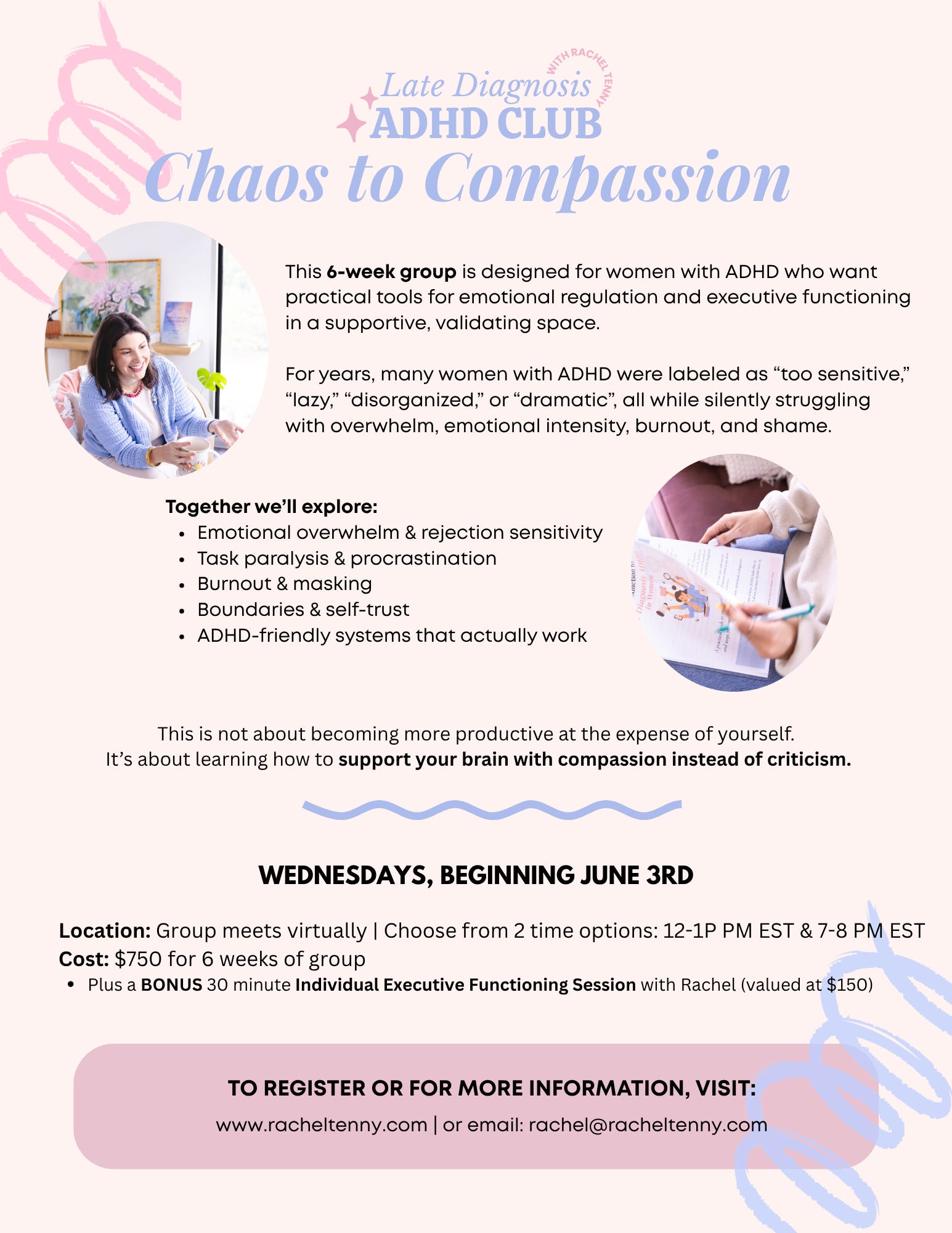
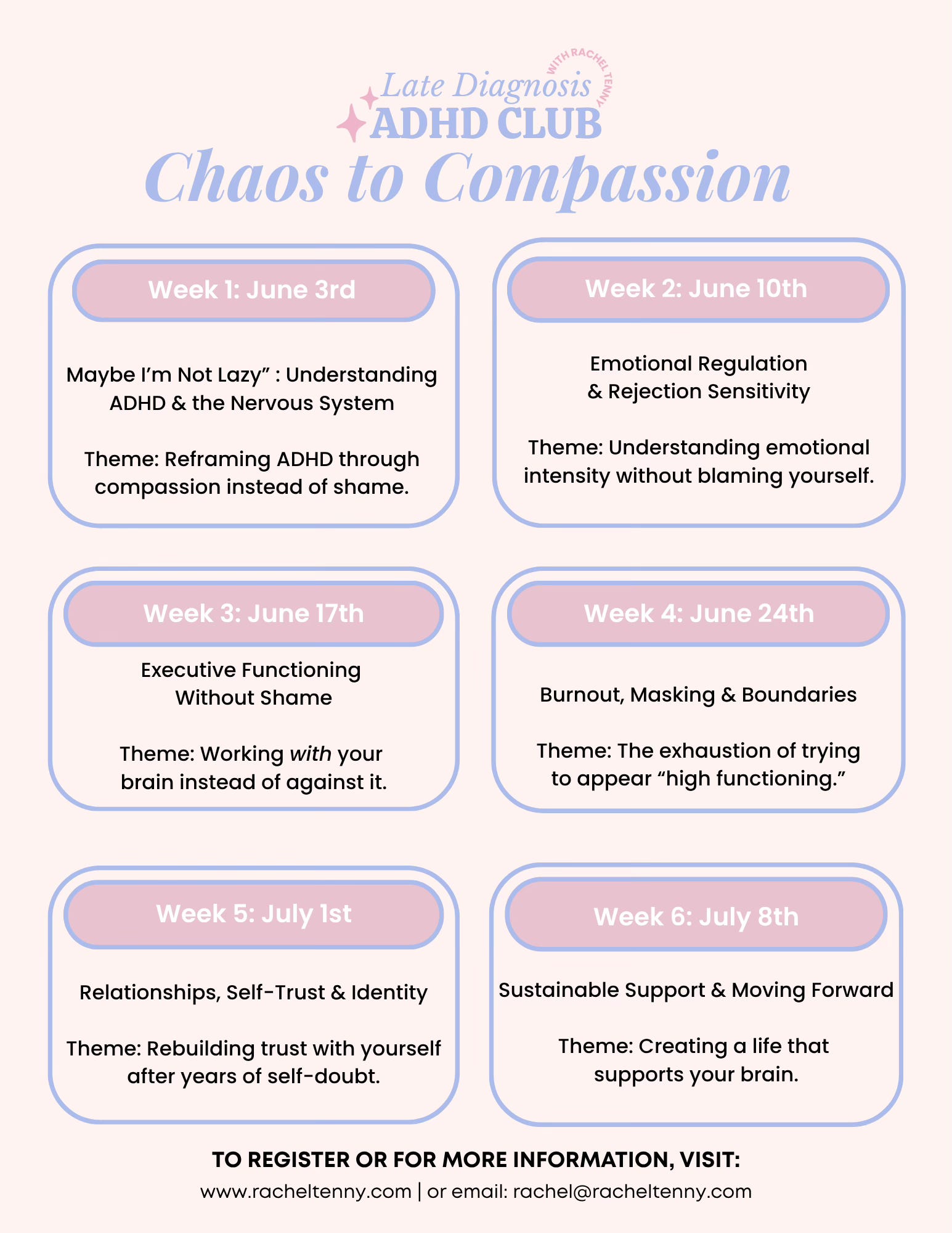
Here’s what we will cover in group each week…
Work with me: I offer virtual counseling in NC and SC as well as coaching for executive functioning support to those outside of NC & SC.
Email: rachel@racheltenny.com for more information.
Resources for ADHD: I have a library of mental health resources and a section just for ADHD and Women with a Late Diagnosis!
Are you a therapist? I offer supervision and consulting for therapists as well as The Therapist Toolbox Resource Library for other providers.
This resonated with me. I can feel the ask get stuck in my throat. It’s easier to do it myself than to push through the discomfort and/or think through what would actually be helpful. As a consequence, I’m constantly overwhelmed, irritated and pushing through to exhaustion. It’s something I’m consciously working on. It’s not easy. But it’s necessary